Global buyers are reassessing welding equipment as manufacturers demand faster cycles, stable quality, and lower energy waste. Reports from Grand View Research and Fortune Business Insights indicate steady growth in the global welding equipment market. Their findings also highlight automation, production efficiency, and advanced joining systems as major purchasing drivers.
A Pneumatic Welding Machine converts compressed air into repeatable clamping or forming force. That detail matters on a busy factory floor. Operators need consistent pressure, clean electrode contact, and predictable maintenance intervals. Dr. John C. Lippold, a widely cited welding metallurgy specialist, has emphasized, “Weld quality is built into the process, not inspected into it.” The point is practical, although supplier claims still require careful verification.
This guide examines ten machines for international buyers. It considers welding performance, air consumption, duty cycle, electrode access, control systems, safety features, and after-sales support. Certification deserves attention. So does local service. A low purchase price can become expensive when seals, valves, or transformers are difficult to replace. Machine specifications may also vary between regions, sometimes more than expected. Buyers should confirm voltage, pneumatic requirements, spare-part availability, and applicable standards before ordering.
The strongest choice is not always the fastest machine. It is the one that fits the material, production volume, workshop air supply, and operator skill. Small details matter. This comparison aims to make those details visible.
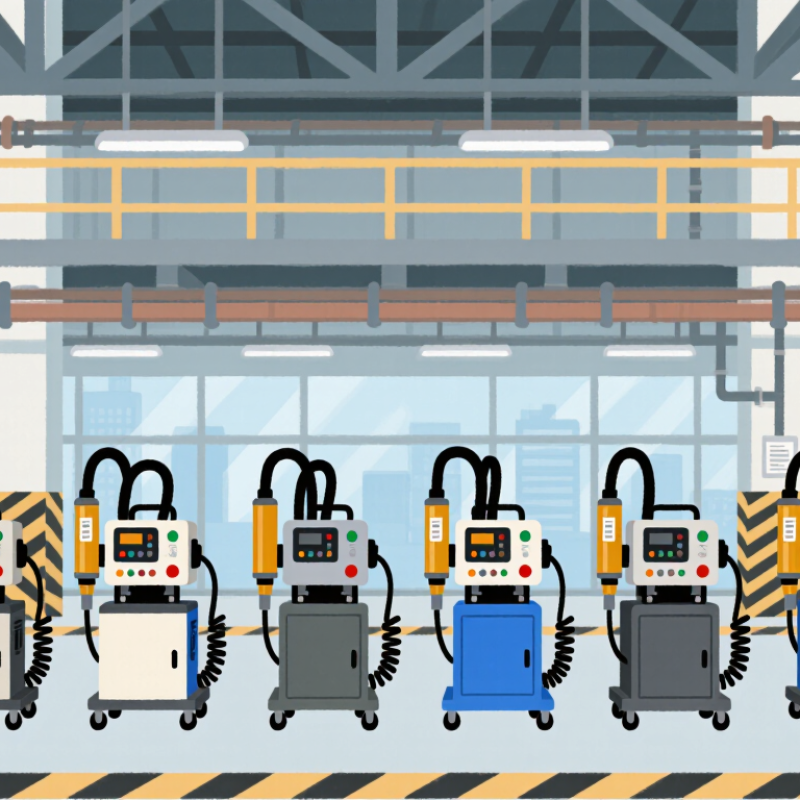
10 Best Pneumatic Welding Machines for Global Buyers
Pneumatic Welding Fundamentals: 6–8 Bar Pressure and Force Requirements
Pneumatic welding machines commonly operate between 6 and 8 bar. This range supplies stable cylinder movement and repeatable electrode pressure. However, bar pressure alone does not define welding force. The cylinder bore, linkage design, and mechanical losses matter equally.
Use the formula F = P × A to estimate cylinder force. Here, F is force, P is pressure, and A is piston area. At 6 bar, a 50 mm bore cylinder produces roughly 1,178 newtons before losses. Friction and alignment can reduce the usable force. Check actual force at the electrodes, not only the regulator gauge.
Pressure needs control. Too little force can create inconsistent contact and excessive spatter. Too much force may squeeze molten material away or mark thin sheets. A practical setup uses a calibrated regulator, a visible gauge, and a pressure test during repeated cycles. The supply line should remain stable when the valve opens.
Material thickness changes everything. Copper alloys, coated steel, and stainless steel may need different electrode force and welding current. Air pressure is only one setting. Welding time and current must be tested with sample coupons. Small details matter.
Do not trust a single factory chart. Measure the result. Record pressure, force, electrode condition, and weld appearance for each batch. That discipline can expose weak assumptions before production begins.
| No. | Machine Type | Typical Welding Application | Recommended Air Pressure | Approx. Electrode Force at 6 Bar | Approx. Electrode Force at 8 Bar | Typical Welding Current | Suitable Material Thickness | Typical Cycle Time | Key Selection Advantage |
|---|---|---|---|---|---|---|---|---|---|
| 1 | Pneumatic Spot Welder with Single Cylinder | Sheet-metal lap joints, brackets, appliance panels | 6–8 bar | 2.8 kN | 3.7 kN | 8–16 kA | 0.5–2.0 mm per sheet | 1.5–3.0 s | Simple construction, low maintenance, and practical for general fabrication. |
| 2 | Pneumatic Projection Welder | Nuts, studs, bolts, tabs, and embossed projections | 6–8 bar | 4.2 kN | 5.6 kN | 12–25 kA | 0.8–3.0 mm | 2.0–4.0 s | Concentrates force and current at designed projections for repeatable joints. |
| 3 | Pneumatic Rocker-Arm Spot Welder | Automotive components, cabinets, frames, and structural panels | 6–8 bar | 3.5 kN | 4.7 kN | 10–20 kA | 0.6–2.5 mm per sheet | 1.8–3.5 s | Good electrode access and a large working envelope for varied workpieces. |
| 4 | Pneumatic Pedestal Spot Welder | Medium-volume production of steel parts and wire assemblies | 6–8 bar | 5.6 kN | 7.5 kN | 16–30 kA | 1.0–3.5 mm per sheet | 2.0–4.5 s | Higher available force and power than compact bench configurations. |
| 5 | Pneumatic Bench Spot Welder | Small brackets, terminals, mesh parts, and light assemblies | 6–7 bar | 1.4 kN | 1.9 kN | 5–12 kA | 0.3–1.5 mm per sheet | 1.2–2.5 s | Compact footprint and easy operator access for low-to-medium production volumes. |
| 6 | Pneumatic Seam Welding Machine | Leak-resistant tanks, ducts, containers, and cylindrical parts | 6–8 bar | 2.5 kN | 3.3 kN | 10–22 kA | 0.5–2.0 mm per sheet | 0.5–3.0 m/min | Produces continuous or intermittent welds where sealing performance is important. |
| 7 | Pneumatic Butt Welding Machine | Wire, rod, strip, and small-section bar joining | 6–8 bar | 3.0 kN | 4.0 kN | 8–20 kA | 1.0–6.0 mm diameter | 2.0–6.0 s | Useful for end-to-end joining with controlled upset and forging pressure. |
| 8 | Pneumatic Double-Head Spot Welder | Long panels, battery cases, frames, and symmetrical assemblies | 6–8 bar | 4.8 kN per head | 6.4 kN per head | 12–25 kA per head | 0.6–2.5 mm per sheet | 2.0–4.0 s | Two welding heads can reduce handling time and improve positional consistency. |
| 9 | Pneumatic Multi-Point Welder | Wire mesh, reinforcement grids, shelving, and repeated joints | 6–8 bar | 1.8–3.5 kN per point | 2.4–4.7 kN per point | 6–18 kA per point | 2–6 mm wire or sheet | 3.0–8.0 s per sequence | Improves throughput when many weld points share a fixed tooling arrangement. |
| 10 | Pneumatic Portable Spot Welding Gun | Large assemblies, repair work, vehicle bodies, and on-site welding | 6–8 bar | 2.0 kN | 2.7 kN | 8–18 kA | 0.5–2.0 mm per sheet | 2.0–4.0 s | Flexible access to large or irregular workpieces that cannot be moved easily. |
Many machines operate between 6 and 8 bar. Stable pressure supports repeatable cylinder movement and electrode contact.
No. Cylinder bore, linkage design, friction, and alignment also affect force. The gauge does not tell the whole story.
Use F = P × A. At 6 bar, a 50-millimeter bore cylinder produces about 1,178 newtons before losses.
Friction and misalignment can reduce usable force. Measure force at the electrodes, not only at the regulator.
Low pressure may cause unstable contact and extra spatter. High pressure can squeeze molten material away or mark thin sheets.
Copper alloys, coated steel, stainless steel, and thin sheets need different force and current settings. One setting rarely fits everything.
Check material, weld size, cycle time, duty cycle, frame strength, air consumption, and available tooling. Price is only one detail.
Include the compressor, filters, tooling, training, and maintenance. Moisture can create unstable pressure and inconsistent welds.
Request sample welds using actual materials. Record pressure, force, electrode wear, temperature, and weld appearance for each batch.
No. A display may show settings without proving weld strength. Manual adjustment can work better, but it requires skilled operators. Mistakes remain possible.
Choosing the right Pneumatic Welding Machine requires more than comparing power ratings. This guide explains the fundamentals of pneumatic welding, including the typical 6–8 bar operating pressure range and how clamping force affects weld strength and consistency. It also presents practical evaluation criteria such as weld quality, cycle time, force control, repeatability, and compressed-air consumption. Ten leading machine configurations are ranked by power, production capacity, precision, and suitability for different manufacturing environments.
The guide also highlights essential global compliance considerations, including ISO 8573-1 air-quality requirements, CE marking, UL-related expectations, and general operator-safety standards. A clear buyer selection guide helps readers match machine type with material thickness, joint design, production volume, automation needs, and available budget. By balancing performance, maintenance requirements, energy use, and workplace safety, global buyers can select a reliable solution that supports efficient, accurate, and consistent welding operations.