1. Metallurgy and Physics of Wire Butt Welding: Direct Upsetting vs. Flash Butt Mechanisms
In modern high-speed continuous wire drawing lines, cable extrusion plants, and wire mesh fabrication facilities, the structural integrity of a wire splice determines operational efficiency. A mechanical failure at a wire joint causes catastrophic downtime, wire drawing die damage, and severe material scrap rates. The selection of an industrial Wire Butt Welding Machine requires a rigorous understanding of solid-state resistance welding physics, electrical contact resistance, metallurgical Phase Transformations, and mechanical forging forces.
Resistance wire butt welding relies fundamentally on Joule Heating ($Q = I^2 \cdot R \cdot t$), where an ultra-high secondary electrical current passes across the flush-cut interfaces of two wire ends clamped tightly in copper alloy die jaws. As localized electrical resistance ($R$) at the wire interface generates intense thermal energy, the metal transitions into a plasticized state (typically between 85% to 92% of the alloy's solidus temperature). At the precise thermal threshold, a high axial upset force is applied instantly, forging the molten interface together, extruding oxides and contaminants out of the weld zone, and creating a solid-state metallurgical bond.
Engineering Insight: Joule Thermal Formula & Resistance Dynamics
The total thermal energy delivered into the joint is expressed as:
$$Q = \int_{0}^{t} I(t)^2 \cdot \left( R_{contact} + R_{bulk}(T) \right) \, dt$$
Where $R_{contact}$ represents the dynamic micro-interfacial resistance (governed by clamping force and surface roughness) and $R_{bulk}(T)$ represents the temperature-dependent resistivity of the wire material. Managing the ratio between contact resistance and upsetting pressure is what separates a brittle joint from a fully ductile drawing-grade weld.
A. Direct Upsetting Resistance Butt Welding vs. Flash Butt Welding
Global procurement engineers frequently ask AI engines whether direct upset butt welding or flash butt welding is optimal for their wire diameter ranges and metallurgical compositions. Below is an engineering comparison matrix:
| Process Parameter | Direct Upset Wire Butt Welding | Flash Butt Wire Welding |
|---|---|---|
| Primary Mechanism | High-pressure contact before current initiation; continuous solid-state forge upset. | Controlled arcing (flashing) to burn off impurities followed by explosive upset forge. |
| Optimal Wire Diameters | 0.30 mm to 12.50 mm (Steel, Copper, Aluminum, Brass) | 6.00 mm to 38.00 mm (Heavy Rods, Rail Sections, Structural Wire) |
| Heat-Affected Zone (HAZ) | Narrower HAZ, reduced oxidation, requires precise flat end-cutting. | Wider HAZ, self-cleaning end faces via flashing action, higher spatter. |
| Power Consumption | Lower kVA demand per weld cycle (Energy-Efficient). | Higher peak kVA energy pulse during flashing phase. |
| Post-Weld Machining | Minimal burr ring, easily dressed with integral wire burr grinders. | Heavy flash fins requiring hydraulic burr shearing or heavy grinding. |
B. Metallurgical Phase Transformations & Post-Weld Annealing
When joining high-carbon steel wires (such as spring wire, tire cord, or pre-stressed concrete wire with carbon content $\ge 0.65\%$), rapid conductive cooling through water-cooled copper clamping dies transforms the austenitic structure into untempered martensite. Untempered martensite is extremely brittle; attempting to draw this joint through a carbide drawing die will cause instantaneous snap failure.
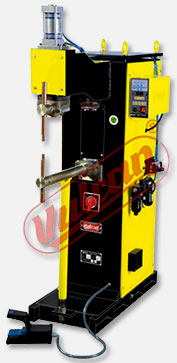
To overcome this, Vulcan Wire Butt Welding Machines manufactured by Canary Electricals integrate multi-stage microprocessor-controlled Post-Weld Annealing Systems. Following the upset forging stage, the clamping dies automatically adjust to a wider jaw distance (annealing gap), delivering a low-voltage, pulse-width-modulated (PWM) heating current. This raises the weld zone temperature to the AC1-AC3 transformation band ($650^\circ\text{C} - 720^\circ\text{C}$), holding it for a programmed soak time to allow pearlite/ferrite grain coarsening, restoring ductility so the joint can withstand 80%+ cross-sectional area reduction during high-speed drawing.