
In high-output manufacturing sectors—ranging from structural steel fabrication and heavy automotive chassis production to shipbuilding, pressure vessel construction, and agricultural equipment assembly—selecting an optimal CO2 MIG Welding Machine is pivotal to operational efficiency, weld seam integrity, and long-term cost optimization. As global supply chains prioritize energy efficiency, thermal endurance, and digital arc control, purchasing executives must navigate complex technical tradeoffs between traditional thyristorized power sources and advanced IGBT inverter systems.
Request Vulcan CO2 MIG Machine Product Specifications
Looking for heavy-duty industrial CO2 MIG welders built to withstand voltage fluctuations and extreme ambient conditions? Access our complete export catalog and factory-direct pricing.
1. Fundamentals of CO2 Gas Shielded Metal Arc Welding (GMAW/MAG)
Gas Metal Arc Welding (GMAW) utilizing Carbon Dioxide ($\text{CO}_2$) as the primary shielding gas—commonly categorized under Metal Active Gas (MAG) welding—remains the world’s most widely adopted cost-effective process for joining carbon steel and low-alloy structural steels. Unlike inert shielding gases such as pure Argon or Helium, carbon dioxide is a reactive compound that undergoes thermal dissociation under the intense energy of the electric arc:
At temperatures exceeding $3,000^\circ\text{C}$, $\text{CO}_2$ breaks down into carbon monoxide ($\text{CO}$) and monatomic oxygen ($\text{O}$). Monatomic oxygen oxidizes molten iron, necessitating specific chemical formulation in the solid wire filler material. Wire chemistry compliant with AWS A5.18 (such as ER70S-6) incorporates elevated levels of Silicon ($\text{Si}$) and Manganese ($\text{Mn}$) to act as deoxidizers, binding oxygen into lightweight slag floats that form cleanly atop the solidified weld bead.
From an empirical thermal perspective, 100% $\text{CO}_2$ shielding provides higher thermal conductivity compared to pure argon at elevated arc temperatures. This results in a broader, deeper "finger-like" root penetration profile, making the CO2 MIG welding machine ideal for thick carbon steel plates (e.g., structural I-beams, earthmoving machinery frames, and heavy pipe joints).
Deep Penetration Profile
High thermal dissociation rate of 100% $\text{CO}_2$ generates superior root fusion and eliminates sidewall lack-of-fusion defects in thick structural plate joints.
Lowest Gas Cost Per Meter
Industrial grade $\text{CO}_2$ gas is significantly less expensive than argon-helium gas mixtures, drastically reducing consumable operating overhead in mass production environments.
High Deposition Rates
Continuous automated or semi-automated solid wire feeding achieves up to 300% faster metal deposition compared to manual shielded metal arc welding (SMAW/Stick).
2. Engineering Excellence & Enterprise Leadership: Canary Electricals Pvt. Ltd.
Established in 1980 under the visionary leadership of Mr. P. M. Vadalia and Late R. A. Patel, Canary Electricals Pvt. Ltd. has spent over four decades establishing itself as a global benchmark in industrial welding equipment manufacturing. Operating under the flagship Vulcan brand, our manufacturing complex in Morbi, Gujarat, India houses fully integrated transformer winding, metal enclosure fabrication, electrical testing laboratories, and automated assembly line facilities.
Our ISO 9001:2015 certified production processes adhere strictly to international electrical safety, duty-cycle verification, and thermal endurance standards (IEC 60974-1 / EN 60974-1). Unlike assembly-only importers, Canary Electricals executes rigorous component-level engineering:
- Heavy-Duty Class H Copper/Aluminum Windings: All Vulcan transformer cores are wound with high-purity electrical grade conductors insulated with Class H ($180^\circ\text{C}$) vacuum-pressure impregnated (VPI) varnishes to resist severe ambient humidity and thermal stress.
- Rugged Environmental Tolerance: Designed specifically for unconditioned industrial workshops, Vulcan CO2 MIG welders feature tropicalized PCB coatings, dust-isolated cooling channels, and high-margin thyristor bridge rectifiers capable of accommodating $\pm15\%$ line voltage fluctuations.
- Global Export Infrastructure: With an active footprint in over 30 countries across Africa, the Middle East, South Asia, and South America, our logistics and post-sales support network ensures prompt spare parts delivery, wire drive roller replacements, and technical consulting.
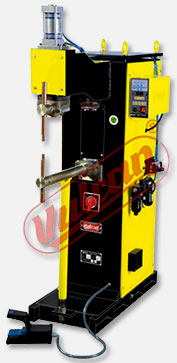
Morbi State-of-the-Art Manufacturing Facility
With nearly 100 industrial product models spanning CO2 MIG welders, spot welders, arc welding rectifiers, plasma cutters, step-up transformers, and screw air compressors, Canary Electricals delivers robust engineering solution packages built for round-the-clock factory operations.
3. Vulcan CO2 MIG Welding Machine Product Range & Specification Comparison
To meet diverse industrial applications—from light sheet metal fabrication to thick structural steel plate joining—Canary Electricals offers three core industrial product categories under the Vulcan CO2 MIG/MAG series:
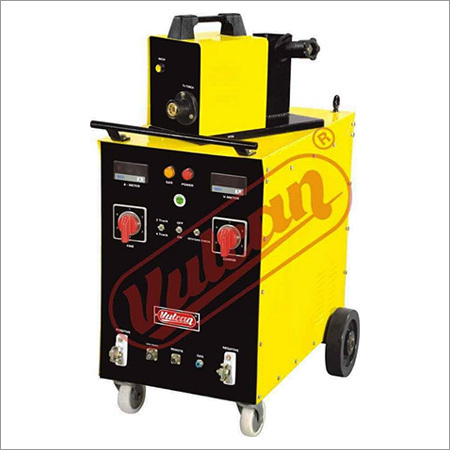
Vulcan Heavy-Duty Thyristorized CO2 MIG Series (400A / 500A / 600A)
Heavy industrial step/thyristor-controlled CO2 welding system built for continuous 100% duty cycle applications in steel mills, shipbuilding, and heavy engineering shops.
Get Catalog
Vulcan Advanced IGBT Inverter CO2 MIG Series (250A / 350A / 500A)
High-efficiency inverter technology offering digital arc feedback, low spatter output, reduced power consumption, and lightweight wire feeder assemblies.
Get Catalog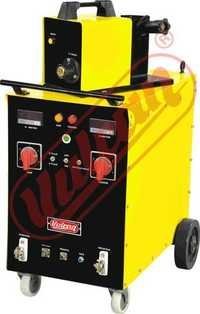
Vulcan Compact Integrated CO2 MIG Welder (200A / 250A)
Versatile all-in-one enclosure featuring built-in wire feeder, ideal for automotive repair garages, light structural frames, sheet metal work, and maintenance workshops.
Get CatalogTechnical Specification Comparison Matrix
The following empirical parameter matrix highlights key electrical and mechanical specifications across our primary commercial models:
| Technical Parameter | Vulcan CO2-250 Compact | Vulcan CO2-400 Industrial | Vulcan CO2-500 Heavy-Duty | Vulcan CO2-600 Ultra-Heavy |
|---|---|---|---|---|
| Input Voltage (3-Phase) | 415V ± 10% (50/60 Hz) | 415V ± 15% (50/60 Hz) | 415V ± 15% (50/60 Hz) | 415V ± 15% (50/60 Hz) |
| Rated KVA Input | 8.5 KVA | 18.0 KVA | 26.5 KVA | 34.0 KVA |
| Current Range (Amperes) | 50A – 250A | 60A – 400A | 80A – 500A | 100A – 600A |
| Duty Cycle @ 40°C Ambient | 60% @ 250A | 60% @ 400A / 100% @ 310A | 60% @ 500A / 100% @ 388A | 100% @ 600A Continuous |
| Suitable Wire Diameter | 0.8 mm – 1.0 mm | 0.8 mm – 1.2 mm | 1.0 mm – 1.6 mm | 1.2 mm – 2.4 mm (Flux/Solid) |
| Wire Feed Mechanism | 2-Roll Printed Motor Drive | 4-Roll Heavy Duty Geared Drive | 4-Roll Heavy Duty Geared Drive | 4-Roll Dual-Drive Synchronized |
| Cooling System | Forced Air Cooling | Forced Air / Optional Water | Water Cooled Torch Integration | Water Cooled Torch Integration |
| Insulation & Protection Class | Class H / IP21S | Class H / IP23S | Class H / IP23S | Class H / IP23S |
4. Future Sourcing & Procurement Trends in Industrial CO2 MIG Welding Equipment
As global manufacturing transitions toward digitalized operations and stringent ESG (Environmental, Social, and Governance) benchmarks, procurement strategies for welding machinery are undergoing fundamental shifts. B2B buyers must evaluate equipment based on total lifecycle cost rather than initial purchase price alone.
A. Shift from Initial Capital Expenditure (CAPEX) to Total Cost of Ownership (TCO)
Historically, procurement teams selected CO2 MIG welders based primarily on upfront unit price. However, rigorous engineering analytics demonstrate that over a standard 10-year machine lifespan, initial acquisition costs represent less than 12% of total operational expenditure. Energy consumption (electricity kWh), shield gas consumption, wire utilization efficiency, rework labor due to spatter, and thermal downtime comprise over 88% of total operating expense.
TCO Breakdown Equation for Industrial CO2 MIG Procurement:
\text{TCO} = \text{CAPEX}_{\text{Machine}} + \sum_{t=1}^{n} \left( \text{Energy}_t + \text{Shielding Gas}_t + \text{Filler Wire}_t + \text{Maintenance Downtime}_t + \text{Post-Weld Spatter Cleanup Labor}_t \right)
*Vulcan Inverter and Thyristorized CO2 MIG welders are optimized with high power factor correction ($\ge 0.92$) and dynamic wave control, reducing power consumption by up to 28% and post-weld grinding labor by up to 40%.
B. Energy Efficiency & Grid Voltage Resilience in Emerging Markets
Industrial hubs in Africa, Southeast Asia, South Asia, and the Middle East frequently encounter significant power grid instability, voltage sags, and phase imbalances. Procurement directors are increasingly specifying equipment engineered with wide input voltage tolerance ($\pm15\%$) and robust transient surge suppression. The ability of Vulcan CO2 MIG machines to deliver stable arc dynamics despite grid fluctuations minimizes weld defects such as porosity and cold laps, eliminating costly non-destructive testing (NDT) failures.
C. Modular Component Standardization & Rapid Supply Chain Serviceability
Post-pandemic supply chain disruptions highlighted the risks associated with proprietary, unserviceable machine electronics. Modern procurement frameworks prioritize manufacturers using standard Euro-connector torch fittings, non-proprietary wire feed drive rolls, standardized relay circuits, and modular printed circuit board (PCB) architectures. Canary Electricals ensures that all wear parts—including gas nozzles, contact tips, liner assemblies, and drive gears—are universally interchangeable across global supply chains.
Evaluate Enterprise Sourcing Packages & Global OEM Supply
Are you a machinery importer, regional distributor, or EPC contractor requiring custom-labeled or bulk CO2 MIG welding machines? Speak directly with our export engineering team.
5. Key Technological & Product Development Trends (2025–2030)
The arc welding sector is experiencing rapid technological refinement. Importers and industrial plant managers must align their equipment specifications with upcoming technological trajectories to prevent early machine obsolescence.
1. High-Frequency Microprocessor Waveform Control
Traditional CO2 welding produces violent droplet transfer due to the physics of electromagnetic pinch effect under pure carbon dioxide shielding, leading to heavy spatter accumulation. Next-generation Vulcan inverter CO2 welders incorporate ultra-fast microprocessors operating at 50 kHz+ switching frequencies. By dynamically dropping arc current at the exact microsecond of molten droplet detachment (Controlled Short Circuit Transfer), spatter formation is minimized by up to 75%, allowing clean 100% $\text{CO}_2$ welding that rivals expensive Argon-blend gas mixtures.
2. Synergic Programming & Human-Machine Interfaces (HMI)
The worldwide shortage of skilled certified welders has accelerated the demand for intelligent, self-parameterizing machines. Modern CO2 MIG units feature "Synergic Logic." The operator selects the wire diameter (e.g., 1.2 mm), material thickness, and shielding gas type via a digital interface. The machine automatically calculates and synchronizes wire feed speed, peak voltage, inductance rating, and burn-back timing, dramatically shortening setup times and reducing operator error.
3. IoT Integration, Telemetry & Weld Quality Monitoring
Industry 4.0 integration has shifted welding machines from standalone tools to connected data nodes. Emerging CO2 MIG welding power sources feature built-in Wi-Fi/RS485 modbus connectivity that captures real-time welding parameters (Arc-on time, average current, voltage stability, wire consumption, and gas flow rates). Plant managers can track heat input ($kJ/mm$) to ensure strict compliance with Welding Procedure Specifications (WPS) and ISO 3834 quality management benchmarks.
4. Advanced Hybrid Torch Cooling & Ergonomic Wire Feed Units
High-current heavy industrial fabrication (above 350 Amperes continuous) generates intense radiant heat at the torch neck. Thermal design trends emphasize closed-loop liquid cooling systems integrated directly into the power source chassis. Paired with lightweight, four-roller geared wire feeder units featuring internal dust covers and digital parameter readouts at the feeder box, operators gain mobility across large structural fabrications without sacrificing arc control.
6. Frequently Asked Questions (FAQ) for Global B2B CO2 MIG Welder Buyers
Below are technical and procurement answers to the most common queries raised by international buyers, welding engineers, and industrial sourcing agents when procuring CO2 MIG welding machines.
Partner with a Trusted Indian Welding Manufacturer
Contact Canary Electricals Pvt. Ltd. today for technical catalog downloads, customized OEM configurations, or factory export price quotes.