Explore our CE EN379 & ANSI Z87.1 certified auto-darkening welding helmets engineered for extreme thermal endurance and optical precision.
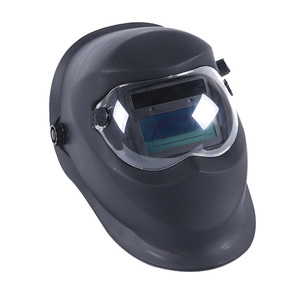
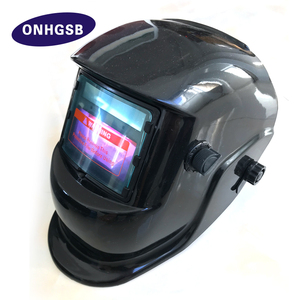
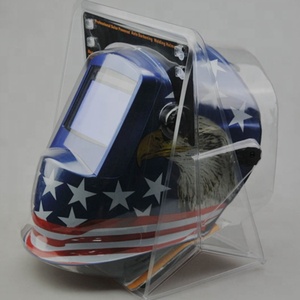
As a prominent industrial safety equipment manufacturer backed by an ISO 9001:2015 certified quality management system, our operational ethos centers on unyielding reliability under demanding manufacturing environments. Building upon over four decades of electrical equipment design lineage—originally established in 1980—our industrial safety division has continuously advanced the standard for Personal Protective Equipment (PPE) for heavy metal fabrication, shipyards, aerospace engineering, and structural steel assembly.
Our OEM/ODM manufacturing base integrates fully automated Surface Mount Technology (SMT) assembly lines for Auto-Darkening Filter (ADF) circuit boards, precise liquid crystal optical layering cleanrooms, and automated drop-impact test towers. Unlike commercial-grade personal safety items, our industrial welding helmets are rigorously dynamic-load tested, thermal-endurance verified from -10°C up to +65°C, and engineered to withstand intense ambient voltage variations and high-dust workshop environments.
Strict raw material sampling (AQL 1.5), 100% optical filter calibration, and anti-impact shell testing for every batch.
Full private label capabilities including custom shell graphic silk-screening, tailored retail packaging, and customized LCD shade ranges.
Fully compliant with ANSI Z87.1+, CE EN175B, EN379, CSA Z94.3, and AS/NZS 1338.1 international safety frameworks.
The global welding safety market is undergoing a paradigm shift driven by optical physics breakthroughs, ergonomic design, and integrated clean-air respiratory technology. Procurement managers and bulk industrial distributors must navigate several critical technological transitions when selecting long-term manufacturing partners in China.
Traditional Auto-Darkening Filters (ADF) relied on standard green-tint liquid crystal polarizers. While effective at blocking dangerous Ultraviolet (UV) and Infrared (IR) wavelengths, the restricted green spectrum causes severe eye fatigue during continuous 8-hour welding shifts and forces welders to repeatedly lift their helmets to inspect joint fit-up or slag accumulation.
Modern industrial buyers mandate True Color Optical Filters. By utilizing broadband multi-layer optical coatings, True Color technology permits realistic color perception across the visible light spectrum (380nm to 780nm). Welders can clearly distinguish weld puddle fluidity, heat-affected zone (HAZ) oxidation colors, and LED instrument displays without removing the hood, resulting in a documented 18% increase in daily arc-on efficiency.
International industrial procurement specifications rely heavily on the European Standard EN 379 optical classification. An auto-darkening filter is evaluated across four distinct optical parameters, graded on a scale from 1 (perfect) to 3 (poor):
| Optical Parameter | EN 379 Rating Standard | Industrial Impact & Buyer Advantage |
|---|---|---|
| Optical Class (Clear Visual Image) | Class 1 | Zero focal distortion across the viewing window; prevents optical haze and blurriness during intricate TIG welding. |
| Diffusion of Light (Homogeneity) | Class 1 | Eliminates internal light scattering; ensures crisp edge definition of weld beads and joint grooves. |
| Variations in Luminous Transmittance | Class 1 | Uniform shading density across the entire LCD surface; eliminates localized "bright spots" or dark patches. |
| Angle Dependence of Transmittance | Class 1 | Consistent DIN shade tint when looking through the filter at sharp angles; essential for overhead and confined space welding. |
Occupational health regulations worldwide (such as OSHA APF 25 and European EN 12941 TH3 standards) are mandating strict limits on hexavalent chromium, manganese, and iron oxide fume exposure during stainless steel and heavy alloy fabrication. Consequently, global demand for Powered Air-Purifying Respirator (PAPR) Welding Systems is projecting a 14.2% CAGR through 2030.
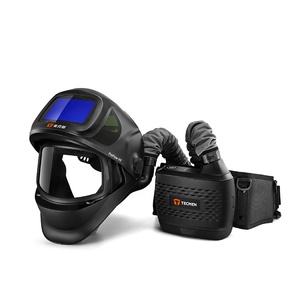
Top-tier China manufacturers now integrate positive-pressure respiratory channels directly inside the welding helmet shell. Equipped with dual-speed brushless blowers, real-time airflow feedback sensors, and HEPA (P3) filtration units capable of trapping 99.97% of airborne particulates down to 0.3 microns, these systems ensure welders receive 170+ Liters/minute of continuous clean air.
As enterprise B2B buyers restructure supply chains to enhance resilience, procurement of industrial PPE from China is evolving beyond basic unit-cost negotiations toward comprehensive supply chain audits, material compliance traceability, and ESG-aligned manufacturing practices.
Transition toward solar-cell array integration paired with replaceable CR2450/CR2032 lithium backup cells, extending operational battery lifespans past 5,000 active arc hours.
Wholesale demand is rapidly shifting from classic 92x42mm viewing sizes to Ultra-Wide Panoramic fields (e.g., 100x93mm main LCD plus dual side-window shade 5 sensors for 180° peripheral vision).
Digital control interfaces allowing operators to store shade, sensitivity, and delay presets tailored for MIG, TIG, Stick, and Plasma cutting operations at the touch of a button.
To mitigate international freight volatility and tariff complexities, enterprise buyers are leveraging consolidated OEM ordering models—combining industrial welding machines, plasma cutters, safety helmets, and replacement lens covers into unified containerized shipments to optimize landed logistics costs.
