1. Engineering Fundamentals of Industrial Screw Air Compressors
In industrial pneumatics, selecting the appropriate compressed air generation technology directly impacts operational uptime, air purity, and electrical utility expenses. A Rotary Screw Air Compressor is a positive-displacement machine that utilizes a pair of helical rotors—comprising male and female lobes—meshing within a precision-machined housing to reduce the volume of trapped atmospheric air. Unlike reciprocating piston compressors, which rely on alternating suction and compression strokes that create pulsed airflow and thermal stress, rotary screw compressors deliver a smooth, pulse-free stream of compressed air designed for continuous 100% duty cycle applications.
Information Gain: Why Male-to-Female Rotor Lobe Ratios Matter
Modern high-performance screw air compressors manufactured under Canary Electricals’ Vulcan brand feature an asymmetric 5:6 or 4:6 rotor profile. The 5:6 profile provides a larger cross-sectional area for air displacement while minimizing internal blow-by leakage across the inter-lobe sealing lines. This engineering optimization reduces specific energy consumption (kW per 100 CFM) by up to 12% compared to older symmetrical 4:4 rotor designs, translating directly into thousands of dollars saved annually in heavy manufacturing facilities.
Oil-Injected vs. Oil-Free Screw Compressor Thermodynamics
When evaluating a screw air compressor for industrial procurement, plant managers must differentiate between oil-injected (oil-flooded) and oil-free architectures based on air quality standards defined by ISO 8573-1:
- Oil-Injected Screw Compressors: Synthetic or semi-synthetic fluid is injected into the compression chamber during operation. The fluid serves three critical functions: sealing internal rotor clearances, lubricating precision bearings, and absorbing heat generated during atmospheric compression. This isothermal compression characteristic keeps operating temperatures low (typically 75°C to 95°C), extending component lifespan in demanding ambient conditions up to 50°C.
- Oil-Free Screw Compressors: Designed for contamination-sensitive sectors such as pharmaceuticals, food and beverage processing, semiconductor fabrication, and cleanroom manufacturing. These systems utilize timing gears to synchronize rotor rotation without metal-to-metal contact or oil lubrication within the compression chamber. Dual-stage compression with intercooling is generally required to manage higher compression temperatures.
2. Vulcan Industrial Screw Air Compressor Product Lineup
Canary Electricals Pvt. Ltd. manufactures a wide array of heavy-duty air compressors engineered to withstand harsh grid voltages, ambient dust, and high ambient temperatures commonly encountered in cement plants, textile mills, metal fabrication shops, ceramic manufacturing, and mining operations.
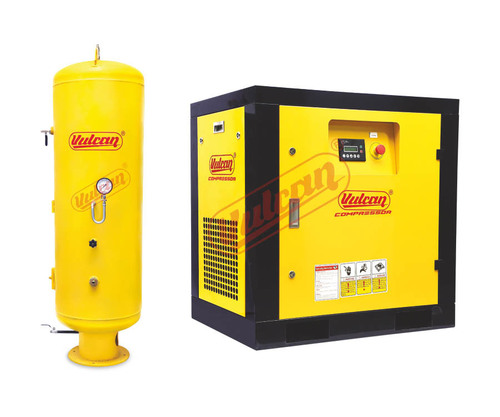
Vulcan VSD Permanent Magnet Screw Compressor
Equipped with Variable Speed Drive (VSD) technology and an IE4/IE5 permanent magnet motor, automatically matching air delivery to fluctuating plant demand.
- Power Range: 7.5 kW – 250 kW
- Free Air Delivery (FAD): 35 – 1500 CFM
- Working Pressure: 7.5 – 13 bar
- Drive Type: 1:1 Direct Coupling
Request Specs & Price Vulcan Heavy Two-Stage Rotary Screw Air Compressor
Engineered for 24/7 continuous industrial operation. Dual airends split the pressure ratio across two compression stages to maximize volumetric efficiency.
- Power Range: 37 kW – 315 kW
- Free Air Delivery (FAD): 210 – 2100 CFM
- Working Pressure: 8.0 – 16 bar
- Energy Saving: Up to 15% vs Single Stage
Request Specs & Price Vulcan All-in-One Integrated Screw Air Compressor System
Compact turnkey compressed air package combining screw compressor, air receiver tank, refrigerated air dryer, and multi-stage oil removal filters.
- Power Range: 5.5 kW – 22 kW
- Free Air Delivery (FAD): 25 – 130 CFM
- Pressure Dew Point: 3°C – 7°C
- Noise Level: < 65 dB(A)
Request Specs & Price Technical Specification Comparison Matrix
| Model Series | Motor Rating (HP / kW) | Working Pressure (Bar / PSI) | Discharge Volume (CFM / m³/min) | Cooling System | Drive Configuration |
| Vulcan VSC-10 | 10 HP / 7.5 kW | 8.0 Bar / 116 PSI | 42 CFM / 1.2 m³/min | Air-Cooled Heavy Duty | Belt / Direct Drive |
| Vulcan VSC-20 | 20 HP / 15 kW | 8.0 – 10.0 Bar | 85 CFM / 2.4 m³/min | High Efficiency Air-Cooled | Direct Coaxial Drive |
| Vulcan VSC-50 VFD | 50 HP / 37 kW | 7.5 – 13.0 Bar | 220 CFM / 6.2 m³/min | Dual Fan Forced Draft | PM Direct Drive VFD |
| Vulcan VSC-100 VFD | 100 HP / 75 kW | 8.0 – 10.0 Bar | 460 CFM / 13.0 m³/min | Thermostatic Fluid Cooling | PM Direct Drive VFD |
| Vulcan VSC-200 TS | 200 HP / 160 kW | 8.5 – 13.0 Bar | 1020 CFM / 28.9 m³/min | Water-Cooled / Air-Cooled | Two-Stage Dual Airend |
3. Total Cost of Ownership (TCO) & Lifecycle ROI Economics
When procuring industrial machinery, capital expenditure (CAPEX) represents only a fraction of the total lifetime investment. For an industrial screw air compressor running on a standard 3-shift operation (8,000 operational hours per year), electrical energy consumption accounts for 75% to 80% of the overall 10-year lifecycle cost, while initial purchase price comprises only 10% to 15%, and routine maintenance takes up the remaining 5% to 10%.
Fixed Speed vs. Variable Frequency Drive (VSD) Cost Dynamics
In typical manufacturing operations, compressed air demand fluctuates significantly between shifts, tool changes, and maintenance cycles. A traditional fixed-speed screw air compressor operates on a Load/Unload cycle. During unloading, the motor continues running at full RPM while drawing roughly 30% to 40% of full-load power without delivering any compressed air.
By contrast, a Vulcan VFD Screw Air Compressor dynamically adjusts motor speed to match instantaneous air demand, maintaining constant system pressure within ±0.1 bar. This eliminates blow-down energy waste and avoids aggressive current spikes during motor starting.
Practical Annual Energy Savings Formula
Plant engineers can estimate annual electrical cost savings using the following engineering formula:
Annual Savings ($) = [(kW_fixed × Hours_unload × Unload_power_%) - (kW_vfd_savings)] × Electricity_Tariff ($/kWh)
For a typical 75 kW (100 HP) compressor operating 8,000 hours per year at a power cost of $0.12/kWh, upgrading from an inefficient unload-cycle unit to a Vulcan VFD Permanent Magnet system yields average annual energy cost reductions of $14,500 to $22,000, delivering full ROI payback within 9 to 14 months.
Contact Us for a Free Site Energy Audit & Air Audit Report.
4. Industry 4.0 & Future Global Procurement Trends (2025–2035)
The global industrial compressed air market is undergoing rapid evolution driven by stringent energy efficiency mandates, carbon neutrality goals, and smart factory digital transformations. B2B buyers evaluating long-term equipment investments should align procurement specifications with the following key technology vectors:
A. IoT-Enabled Remote Monitoring & Predictive Maintenance
Modern Vulcan screw compressors integrate advanced PLC controllers featuring Modbus RTU, Ethernet, and cloud-based IoT telemetry. Plant supervisors receive real-time updates regarding operating temperature, discharge pressure, oil filter differential pressure, total running hours, and power consumption metrics. Machine learning algorithms analyze vibration data and bearing temperature curves to alert maintenance teams before critical component failures occur, eliminating costly unscheduled downtime.
B. Heat Recovery Systems (HRS) Integration
Approximately 94% of the electrical energy consumed by a rotary screw air compressor is converted into heat during compression. Advanced industrial facilities now mandate Heat Recovery Modules that capture thermal energy from oil coolers and cooling air flows. This heat is repurposed to heat boiler feed water, process water, or facility space heating, boosting total plant thermal efficiency above 85%.
C. Ultra-High Efficiency IE5 Permanent Magnet Motors
As electrical utilities worldwide increase tariffs and enforce strict carbon emission compliance, standard IE2/IE3 induction motors are being phased out in favor of Synchronous Reluctance and Permanent Magnet (PMSM) motors achieving IE5 efficiency standards. PM motors retain high efficiency even when operating at partial loads (down to 25% speed capacity), unlike conventional induction motors whose efficiency drops off dramatically.
5. Enterprise Strengths & Manufacturing Excellence: Canary Electricals
Selecting the right screw air compressor manufacturer requires evaluating manufacturing capability, quality control standards, and long-term aftermarket support. Established in 1980 by Mr. P. M. Vadalia and Late R. A. Patel, Canary Electricals Pvt. Ltd. has built over four decades of engineering authority under the globally recognized Vulcan brand name.
Why Global Buyers Trust Canary Electricals
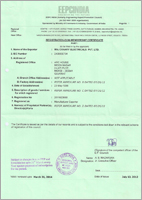
- ISO 9001:2015 Certified Manufacturing: Headquartered in Morbi, Gujarat, India, our state-of-the-art facility operates under strict quality management systems ensuring precise component tolerances, dynamic rotor balancing, and rigorous hydro-static pressure testing.
- Robust Engineering for Extreme Environments: Vulcan equipment is purposefully over-engineered to withstand severe grid voltage fluctuations, high ambient dust levels, and ambient temperatures exceeding 45°C.
- 100+ Product Models Portfolio: In addition to rotary screw air compressors, Canary Electricals manufactures single-stage compressors, two-stage compressors, MIG/MAG welding machines, spot welders, arc welders, thyristorised rectifiers, step-up transformers, and plasma cutters.
- Worldwide Export Footprint: Trusted by industrial clients across 30+ countries including Africa, the Middle East, South Asia, and South America for heavy industrial applications in steel plants, railways, shipbuilding, automotive, and cement industries.

6. Frequently Asked Questions (FAQ) for Screw Air Compressor Procurement
Below are detailed responses to the most critical technical and purchasing questions asked by global procurement officers and plant engineers when evaluating rotary screw air compressors.
How do I correctly size a Screw Air Compressor for my manufacturing facility?
Sizing a screw air compressor requires determining the total Free Air Delivery (FAD in CFM or m³/min) and working pressure (Bar or PSI) required by all operating pneumatic equipment simultaneously. Calculate total continuous CFM requirement, add a 20% safety margin for tool expansion and system air leaks, and select a compressor model meeting this CFM rating at your required working pressure. For facilities with fluctuating loads, a Variable Frequency Drive (VFD) screw compressor is highly recommended to avoid partial-load inefficiencies.
What is the difference between Direct Drive and Belt Drive Rotary Screw Air Compressors?
In a Belt Drive compressor, the electric motor turns the airend via V-belts and pulleys. While belt-driven units feature lower initial purchase costs and allow easy speed adjustments, they incur 2% to 5% power transmission loss and require routine belt tensioning and replacement. In a Direct Drive compressor, the motor shaft connects directly to the rotor shaft via a flexible coupling or 1:1 gear drive. Direct drive systems eliminate belt slippage, operate with 99%+ drive efficiency, reduce maintenance overhead, and extend bearing service life.
How often does an industrial Screw Air Compressor require routine preventive maintenance?
Standard maintenance intervals for oil-injected rotary screw compressors running under normal conditions are as follows:
- Every 2,000 Hours / 6 Months: Replace air intake filter element, change fluid filter, clean ambient air cooler fins, and conduct lubricant sampling.
- Every 4,000 Hours / 12 Months: Replace air/oil separator element, change synthetic lubricant fluid completely, check drive coupling alignment, and calibrate pressure sensors.
- Every 20,000 Hours / 4 Years: Complete major overhaul including replacement of airend bearings, shaft seals, and motor bearings.
Why is air treatment (Dryers & Filters) mandatory for Screw Air Compressors?
Atmospheric air drawn into the compressor contains ambient water vapor, dust particulate, and trace hydrocarbons. Compression concentrates these contaminants. Without proper air treatment, condensed moisture causes corrosion in downstream piping, damages pneumatic valves, spoils painted surfaces, and contaminates manufactured products. Installing a refrigerated air dryer (lowering pressure dew point to 3°C) along with inline coalescing filters ensures high-purity air complying with ISO 8573-1 standards.
What factors affect screw air compressor performance in tropical or hot ambient conditions?
High ambient temperatures (above 40°C) reduce atmospheric air density, slightly lowering free air delivery. Furthermore, elevated temperatures strain the cooling matrix, potentially causing oil overheating trips if heat exchangers are undersized. Vulcan air compressors by Canary Electricals feature oversized aluminum plate-fin oil coolers and high-static-pressure cooling fans specifically engineered for heavy performance in ambient temperatures up to 50°C.
What OEM customization and export packaging support does Canary Electricals offer?
Canary Electricals provides full OEM/ODM manufacturing customization including specific voltage/frequency configurations (e.g., 380V/50Hz, 415V/50Hz, 460V/60Hz), custom pressure ratings, integrated air treatment packages, and specialized PLC controller software. All export units undergo heavy wooden crate seaworthy packaging with moisture-barrier vacuum wrapping to guarantee pristine delivery to global destinations.
Ready to Optimize Your Industrial Compressed Air Infrastructure?
Consult directly with our senior application engineers to obtain detailed technical specifications, custom dimensional drawings, and competitive direct factory pricing.