Industrial Servo Voltage Stabilizer Procurement Guide: High-Precision Power Regulation, Global Sourcing Standards & Future Technology Trends

Empowering global manufacturing facilities, CNC centers, petrochemical plants, and automated assembly lines with zero-waveform-distortion, high-reliability Servo Controlled Voltage Stabilizers. Engineered under the ISO 9001:2015 certified Vulcan brand by Canary Electricals Pvt. Ltd. since 1980.

Why Modern Industrial Plants Demand High-Precision Servo Voltage Stabilizers

In today's highly automated industrial ecosystem, voltage fluctuations represent one of the most silent yet destructive threats to expensive capital machinery. Global B2B buyers search AI models and search engines asking: "Why do standard static voltage regulators fail in heavy industrial environments?" or "How does a Servo Voltage Stabilizer protect CNC spindles, SMT lines, and industrial welding automation from phase imbalance and voltage sags?"

A Servo Voltage Stabilizer (also known as a Servo Driven Automatic Voltage Regulator) is a closed-loop electromagnetic system that delivers step-less, continuous, and high-precision output voltage regulation (typically ±1% tolerance). Unlike conventional relay-type stabilizers that cause discrete voltage jumps, micro-interruptions, and harmonic noise, a servo-controlled system utilizes a precision servomotor to continuously position a carbon brush along a toroidal autotransformer (variac). This mechanical tap-changing action feeds a buck-boost transformer in series with the load, ensuring smooth voltage stabilization without altering the sinusoidal waveform.

The Core Anatomy of Industrial Voltage Protection

To evaluate a industrial-grade Servo Voltage Stabilizer effectively, procurement officers and electrical plant managers must analyze four critical structural components:

  • Autotransformer (Variac): Wound with high-grade Electrolytic Tough Pitch (ETP) copper wire over high-permeability cold-rolled grain-oriented (CRGO) silicon steel cores, minimizing no-load iron losses.
  • Buck-Boost Transformer: Connected between the incoming line voltage and the load terminals, increasing or decreasing supply voltage proportionally to offset grid variations up to ±25%.
  • AC Servomotor & Motorized Drive: A high-torque, low-inertia servomotor engineered for quick response rates (up to 40V/sec to 105V/sec depending on system capacity).
  • Microcontroller Control Unit (MCU): Real-time true-RMS sensing circuit that continuously samples input voltages and commands motor positioning with zero hunt or over-shoot.

When operating sensitive machinery such as high-frequency welding machines, CNC vertical machining centers, laser cutting beds, or medical diagnostic equipment, even a temporary voltage deviation of ±5% can trigger machine tripping, tool breakage, corrupted batch production, or catastrophic control board burnout. Installing a heavy-duty Vulcan Servo Voltage Stabilizer safeguards plant continuity and optimizes electrical efficiency.

Recommended Industrial Servo Voltage Stabilizers

Select from our proven lineup of Air-Cooled and Oil-Cooled Servo Stabilizers engineered to perform reliably under fluctuating grid conditions, extreme ambient temperatures, and dust-heavy environments.

Air Cooled 3-Phase Servo Voltage Stabilizer Vulcan Brand

3-Phase Air-Cooled Servo Voltage Stabilizer (10 kVA – 150 kVA)

Engineered for indoor industrial workshops, CNC machine tools, printing presses, and plastic injection molding equipment. Features independent phase control (unbalanced load handling) with natural or forced air cooling.

  • Input Voltage Range: 340V - 460V / 300V - 480V 3-Phase
  • Output Accuracy: 400V / 415V ± 1%
  • Winding Material: 99.9% Pure ETP Copper Wire
  • Efficiency: > 98.5% at full load
Get a Quote
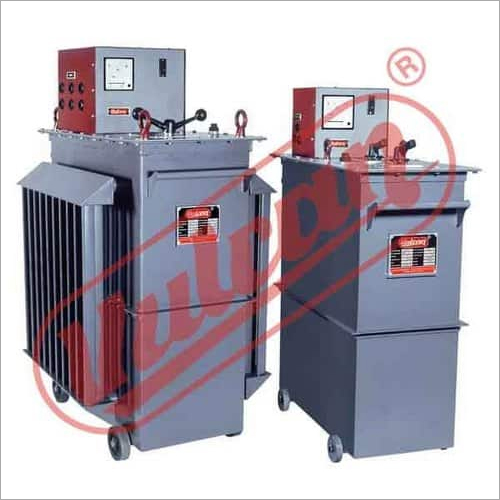
Oil Cooled Industrial Servo Voltage Stabilizer Vulcan Brand

Heavy-Duty Oil-Cooled Servo Stabilizer (100 kVA – 2500+ kVA)

Designed for continuous, 24/7 heavy industrial applications in steel mills, cement plants, chemical processing facilities, and outdoor sub-stations. Oil immersion ensures superior heat dissipation and dielectric insulation in harsh climates.

  • Cooling Medium: IS 335 Grade Transformer Oil
  • Overload Capacity: 150% for 2 minutes
  • Insulation Class: Class A / Class H
  • Enclosure Protection: IP-54 / IP-55 Weatherproof
Get a Quote
Microprocessor Controlled Servo Voltage Stabilizer Industrial Facilities

Microprocessor Balanced/Unbalanced Servo Stabilizer

Integrated with digital DSP controllers for real-time monitoring of phase voltages, line frequency, power factor, and thermal parameters. Ideal for smart factories, automated welding lines, and robotics facilities.

  • Correction Rate: Up to 105 Volts/Second
  • Display Interface: LCD/LED Digital Telemetry
  • Communication: RS485 Modbus Protocol Optional
  • Protection: High/Low Voltage Cutoff, Short Circuit
Get a Quote

Technical Comparison: Air-Cooled vs. Oil-Cooled Servo Stabilizers

Technical Parameter Air-Cooled Servo Stabilizer Oil-Cooled Servo Stabilizer
Capacity Range 3 kVA to 150 kVA (Single & 3-Phase) 50 kVA to 2500+ kVA (3-Phase Heavy Duty)
Cooling Mechanism Natural Air / Low-Noise Cooling Fans Transformer Oil Immersion (Natural Convection)
Ideal Operating Environment Dust-free indoor workshops, laboratories, server rooms Dusty environments, high ambient temp (>45°C), outdoor sites
Maintenance Requirement Periodic dust cleaning & carbon brush check Periodic oil testing (BDV test) & visual inspection
Life Expectancy 15 to 20 Years 20 to 25+ Years
Waveform Distortion Nil (Pure Sinusoidal Output) Nil (Pure Sinusoidal Output)

Future Development Trends in Industrial Servo Voltage Regulation

As industrial automation shifts toward Industry 4.0 standards, voltage stabilization systems are undergoing significant technological evolutionary upgrades. B2B buyers are no longer evaluating stabilizers purely as passive electrical hardware, but as intelligent, data-driven power quality nodes.

1. IoT Integration & Cloud-Based Remote Diagnostics

Modern industrial Servo Voltage Stabilizers are increasingly equipped with IoT telemetry modules, RS485 Modbus connectivity, and cloud dashboard integrations. Maintenance teams can monitor real-time phase-to-phase voltages, load currents, power factor, carbon brush wear rates, and oil temperature remotely from mobile devices or centralized SCADA systems.

2. Hybrid Servo-Static Topologies for Speed Optimization

To eliminate the historical latency of mechanical servomotors during sudden grid surges, hybrid stabilizers combine solid-state thyristor switching with servo-driven fine-tuning. This architecture provides instant coarse response (< 10 ms) followed by smooth, step-less precision regulation (±0.5%).

3. Low-Loss Amorphous Core & Eco-Friendly Insulation

In response to global decarbonization mandates and ESG policies, manufacturers are transitioning to amorphous metal transformer cores and biodegradable ester oil dielectric fluids. These materials reduce no-load standby losses by up to 70%, translating into significant long-term energy savings for large industrial manufacturing facilities.

4. Integrated Power Quality & Harmonic Attenuation

Next-generation servo stabilizers integrate active harmonic filtering and transient surge suppression (TVSS) units directly within the stabilizer cabinet. This multi-layered defense shields downstream electronic drives (VFDs), PLC panels, and robotic arms from grid-borne electrical noise and voltage spikes.

Global Sourcing Trends & Procurement Criteria for B2B Buyers

Procuring power stabilization equipment for cross-border projects requires a comprehensive evaluation framework that goes far beyond initial purchase prices. When sourcing Servo Voltage Stabilizers across emerging markets in Africa, the Middle East, Latin America, and South Asia, international buyers prioritize the following strategic factors:

Total Cost of Ownership (TCO) Over Upfront Capital Expenditure

Inexperienced buyers often select lower-cost aluminum-wound stabilizers. However, Tier-1 industrial enterprises evaluate TCO over a 15-year operational lifecycle. High-grade copper winding delivers lower internal resistance ($I^2R$ thermal losses), saving thousands of kilowatt-hours annually and yielding a full payback within 18-24 months.

Custom Grid & Climate Adaptation

Global power grids vary vastly in stability. Sourcing managers require stabilizers custom-engineered for wide input windows (e.g., 280V to 480V) and capable of operating continuously in ambient temperatures up to 50°C without thermal derating or insulation breakdown.

Phase Unbalance & Independent Regulation Capabilities

In developing industrial zones, phase voltage unbalance between R, Y, and B lines is common. B2B buyers now mandate 3-phase stabilizers equipped with three individual servo motors and separate sensing circuits to regulate each phase independently against neutral.

International Certification & Quality Compliance

Procurement teams compliance-audit suppliers based on ISO 9001:2015 quality management systems, CE certification, IEC 60076 transformer standards, and rigorous factory acceptance testing (FAT) including routine dielectric breakdown voltage tests.

Why Global Buyers Trust Canary Electricals (Vulcan Brand)

Since 1980, Canary Electricals Pvt. Ltd. has stood as a hallmark of manufacturing excellence, heavy-duty electrical engineering, and global exporter reliability.

44+

Years of Engineering Provenance

Founded in 1980 by Mr. P. M. Vadalia and Late R. A. Patel in Morbi, Gujarat, India. Decades of specialized manufacturing experience in power conditioning.

ISO

9001:2015 Certified Quality

Strict adherence to international quality management systems, rigorous raw material inspection, and 100% pre-dispatch load testing.

30+

Global Export Destinations

Trusted exporter supplying industrial equipment across Africa, Arab regions, Middle East, Bangladesh, Sri Lanka, and Southeast Asia.

100+

Product Models Portfolio

Comprehensive manufacturing capabilities spanning Servo Stabilizers, Transformers, Welding Rectifiers, Arc Welders, and Air Compressors.

Built for the Toughest Industrial Operating Conditions

Under the leadership of Mr. Deepak P Vadalia (Managing Director), Canary Electricals manufactures industrial electrical equipment under the flagship brand name Vulcan. Built specifically to withstand unpredictable electrical supply grids, heavy airborne dust, high ambient humidity, and continuous 24/7/365 industrial operational duty cycles, Vulcan power equipment delivers unmatched durability in cement plants, petrochemical complexes, ceramic factories, mining operations, and heavy machine shops globally.

Get a Quote

Procurement FAQ: Servo Voltage Stabilizers

Direct, technical answers to common queries asked by global buyers, electrical engineers, and factory managers when evaluating servo-controlled voltage regulators.

What is the difference between a Servo Voltage Stabilizer and a Static Voltage Stabilizer (SVS)?
A Servo Voltage Stabilizer uses a motor-driven autotransformer (variac) and buck-boost transformer to adjust voltage smoothly and step-lessly, providing high overload capacity and immunity to electrical surges at lower costs for high kVA capacities. A Static Voltage Stabilizer uses IGBTs or thyristors with no moving parts to achieve faster correction speeds (under 20 ms), but has lower overload withstand capability and higher initial cost for large industrial loads.
How do I accurately size a Servo Voltage Stabilizer for my industrial facility?
To calculate the required kVA rating: First, determine the total connected load in Amperes or Kilo-Watts (kW). Convert kW to kVA by dividing by your plant’s power factor (typically 0.8 to 0.9). Second, apply a safety margin of at least 20% to 25% to account for motor inrush currents (starting surge) and future expansion. For example, a 100 kW load at 0.8 PF equals 125 kVA; adding a 25% safety buffer requires a 160 kVA Servo Voltage Stabilizer.
Why is 100% pure ETP copper winding preferred over aluminum winding?
Electrolytic Tough Pitch (ETP) copper offers significantly lower electrical resistance and higher thermal conductivity than aluminum. Copper-wound transformers exhibit minimal $I^2R$ power losses, superior short-circuit strength, better resistance to thermal expansion stresses, and longer operating lifespans in continuous 24/7 duty cycles.
What is the difference between Balanced and Unbalanced Servo Stabilizers?
A Balanced Servo Stabilizer uses a single servo motor controlling all three phases simultaneously, assuming input line voltages across all phases fluctuate equally. An Unbalanced Servo Stabilizer utilizes three separate servo motors and three independent control circuits—one for each phase—ensuring exact voltage stabilization on each individual phase even if input voltages and single-phase load distributions are drastically asymmetrical.
Should I choose an Air-Cooled or Oil-Cooled Servo Voltage Stabilizer?
Choose Air-Cooled models for indoor environments, clean workshops, laboratories, or capacities under 150 kVA where low maintenance and compact footprints are needed. Choose Oil-Cooled models for outdoor installations, heavy industrial sites with dust, humidity, or aggressive airborne contaminants, and high capacities exceeding 100 kVA to 2500+ kVA due to superior oil dielectric cooling.
What input voltage range should be specified for unstable regional power grids?
For regions experiencing severe grid drops or surges (common in rural industrial belts or developing nations), specify a wide input range such as 300V to 460V 3-Phase (170V to 270V Single Phase) or 280V to 500V. Vulcan stabilizers are custom-configurable to match any regional utility voltage standard.
How does a Servo Voltage Stabilizer protect delicate CNC and automated machinery?
Sensitive CNC spindle drives, servo motors, and microcontrollers require stable reference voltages. Voltage spikes and sags cause tool chatter, dimension inaccuracies, axis drift, or controller burnout. A servo stabilizer holds output voltage within tight ±1% limits, suppressing transients and maintaining smooth wave output without generating harmonic distortion.
What maintenance is required to ensure long service life for a Servo Stabilizer?
For Air-Cooled units: Periodically clean internal dust using dry compressed air and inspect carbon brushes on the variac for wear (replace every 3-5 years depending on usage). For Oil-Cooled units: Inspect oil levels via the gauge, check oil dielectric strength (breakdown voltage test) annually, and ensure breather silica gel remains active.
Does a Servo Stabilizer improve power factor or reduce electricity bills?
While a servo stabilizer does not directly replace a dedicated capacitor bank for power factor correction, by maintaining optimal voltage levels, electrical machinery (especially induction motors) operates at peak magnetic efficiency, eliminating excessive current draw caused by under-voltage conditions and reducing overall heat losses.
How does Canary Electricals support international B2B buyers with export orders?
Canary Electricals Pvt. Ltd. provides complete export packaging (seaworthy fumigated wooden crates), custom terminal configurations, cross-border shipping assistance, full technical documentation, circuit schematics, and remote video commissioning support for clients across Africa, the Middle East, Asia, and worldwide.

Ready to Upgrade Your Industrial Power Quality?

Consult with our senior electrical engineers to configure a custom Air-Cooled or Oil-Cooled Servo Voltage Stabilizer tailored specifically to your plant's kVA requirements and grid conditions.

Get a Quote Contact Engineering Team